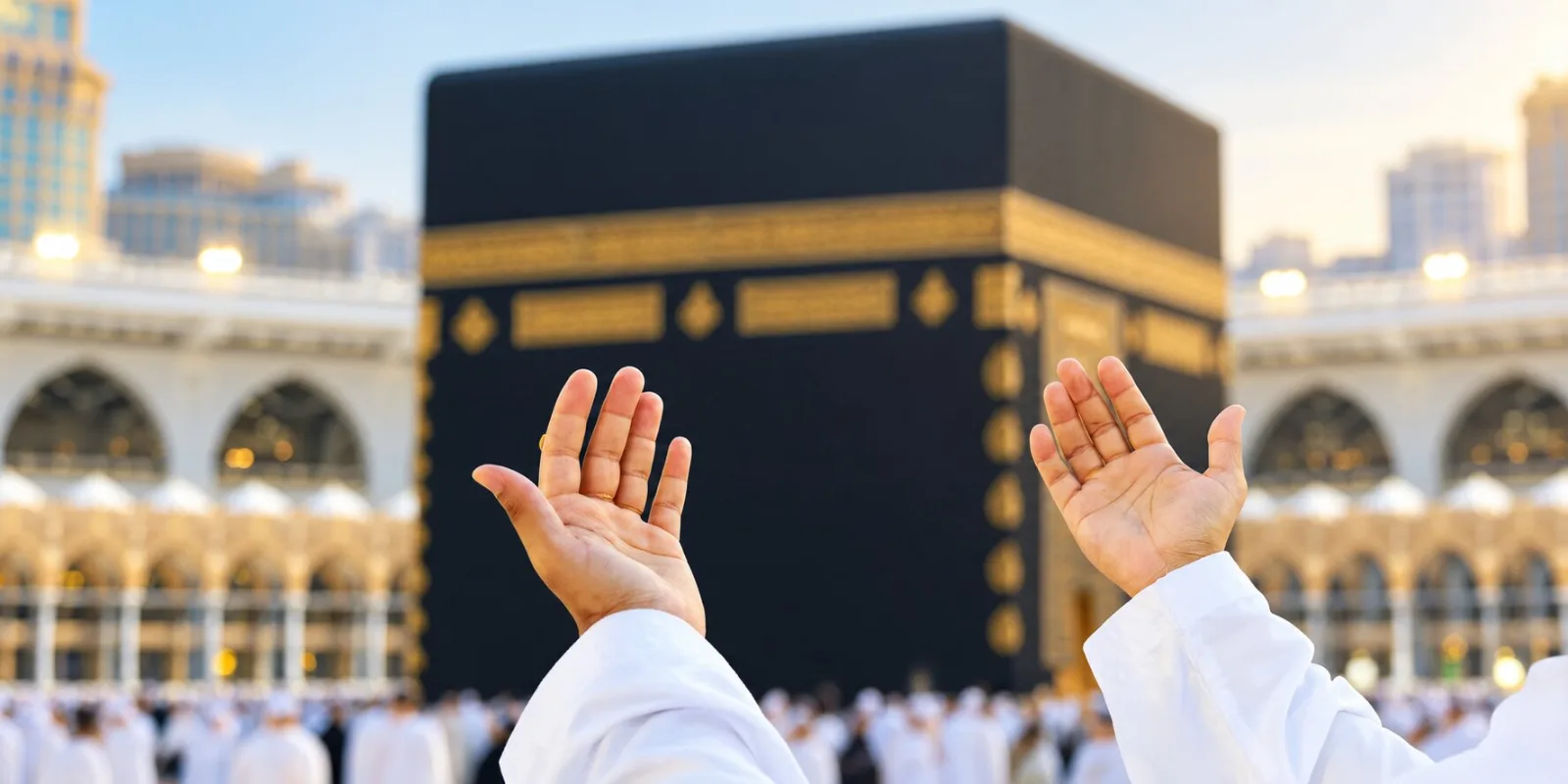
How Many Riders, How Few Pilgrims
The airport doors slide open. Garlands, relatives craning their necks, bottles of Zamzam passed from hand to hand, a new title attached to a familiar name. Every culture has its own version of this scene, and every version is beautiful.
But the real result of Hajj isn't visible at that gate. It shows up three months later — in the tone of voice used with a shop assistant, in what happens to that long-running dispute with a neighbour, in whether the feet actually hit the floor when the Fajr adhan sounds.
Mujahid once looked out over the crowds and said, "How many pilgrims!" Ibn 'Umar corrected him: How few. Rather say, how many riders.
Millions travel. Not every journey comes home as Hajj.
And the Hajj the Prophet ﷺ spoke about carries a reward that stops the heart: there is no reward for Hajj mabroor except Paradise. (Al-Bukhari)
So the only question worth asking is this: how does my Hajj become that Hajj?
What's inside the word "mabroor"
Mabroor comes from the Arabic root birr, and birr is used in two senses.
First — good conduct toward people. In a hadith: al-birr is good character. (Muslim)
Second — abundant worship and taqwa, the opposite of sin and heedlessness.
Al-Qurtubi noted that the various explanations of Hajj mabroor all circle the same meaning: performing the rites completely, the way the Sharia asks, while staying clear of sin.
Notice what isn't in that definition. No accounting of who completed the most tawaf, who prayed closest to the front, who stayed the longest. Just two things: your relationship with Allah, and your treatment of people.
The Companions asked directly
Jabir ibn 'Abdullah narrated that the Companions put the question to the Prophet ﷺ plainly: Messenger of Allah, what makes Hajj mabroor?
The answer was startling in its simplicity:
"Feeding people, and spreading the greeting of salam."
Sit with that. A pilgrimage whose reward is Paradise, and its key is handed over in the form of sharing food and greeting strangers.
Sa'id ibn Jubayr was once asked which pilgrim is best. He said: the one who feeds others and guards his tongue.
Ibn 'Umar put it even more simply: righteousness is an easy thing — a bright face and a gentle word.
Which means that shifting your bag to make room for the man next to you in the Mina tent, giving up your seat on the bus to an elderly aunty, walking a lost pilgrim back to his group instead of pointing vaguely down the road, splitting your meal box with someone who didn't get one — none of this is "good deeds done in the gaps between rituals."
This is the ritual.
When the provision itself is unlawful
The journey of Hajj is a journey of answered prayers. But the Prophet ﷺ also said: Allah is Good, and accepts only what is good. (Muslim)
He described a man on a long journey, hair dishevelled, feet covered in dust, stretching his hands to the sky calling, "O Lord! O Lord!" — while his food is unlawful, his drink unlawful, his clothing unlawful. So how could he be answered?
This part stings, and it should. Where the money came from is not a question to ask in Makkah. It's a question to ask before the ticket is booked. Interest-based wealth, a bribe, a supplier shortchanged, wages withheld from an employee who needed them — carrying that to the Ka'bah and calling out Labbayk is close to arriving empty-handed.
And the encouraging inverse is just as true: a modest package paid for with clean money is worth immeasurably more than a luxury package paid for with money that isn't.
A small hole in the intention
The Prophet ﷺ himself used to make this supplication:
"O Allah, a Hajj with no riya' in it, and no sum'ah." (Ibn Majah)
Riya' is doing something so that people see it. Sum'ah is doing it so that people hear about it.
This test is harder now than it has ever been. A phone in every pocket, a live stream in front of the Ka'bah, a caption waiting to be written, a notification count to check afterward. Taking a photograph is not a sin. But there's a question worth asking quietly, once, and answering honestly:
If no one on earth would ever know I made this journey, would I still want it this badly?
Keep the answer to yourself. Just make sure you find it.
What has to happen before you leave
The journey begins before the bags are packed. The preparation scholars emphasise looks something like this:
Sincere repentance. Settle the old account with Allah before opening a new one.
Discharge what you owe people. Return trusts, pay debts, and where you can't pay, ask for time. Go to the person you wronged and ask for pardon.
Write your will. Travel carries risk. Writing it isn't pessimism; it's responsibility.
Provide for your family. Arrange expenses, guidance and someone to look after matters until you return. A heart left behind at home cannot stand fully at 'Arafah.
Choose righteous companions. People who steady you when you weaken, remind you when you forget, and teach you what you don't know. Avoid two kinds of company: the kind that pulls you into sin, and the kind that burns time on things with no weight in the hereafter.
Learn. The miqat, ihram, tawaf, sa'i, the days of Mina, the stoning — and the travel rulings too: shortening and combining prayers, tayammum, wiping over socks.
That last point deserves a sentence of its own. Going to Hajj without learning it is a little like standing in a congregational prayer without knowing how to pray. You can follow everyone else down into rukuʿ and sujud. Whether the prayer actually counts is a separate question.
Crowds, delays, and a shove in the back
Allah says that during Hajj there is to be no rafath, no fusuq, no jidal — no obscenity, no disobedience, no quarrelling. (Al-Baqarah 2:197)
Easy to read. In practice?
The bus has been stuck for eight hours. The air conditioning in the tent has failed. Dinner still hasn't arrived. Your sandals are gone. Someone has just elbowed past you.
These moments — not the ceremonial ones — are where it is decided whether your Hajj is mabroor.
'Ata' explained jidal as arguing with your companion until you anger him and he angers you. And when the Prophet ﷺ heard shouting and rough handling on the way from Muzdalifah, he said: "O people, be calm. Rushing and pushing are not righteousness." (Ahmad)
One reframing makes much of this bearable: Hajj is not a holiday, it is worship. The discomfort isn't a flaw in the trip. The discomfort is part of the syllabus. The patience exam isn't administered separately; it's hidden inside the traffic jam.
And it's worth remembering that not very long ago, people crossed deserts for months to reach this place — through disease, bandits and heat, with no guarantee of returning at all.
The time is short, and it isn't coming back
Every hour in Makkah and Madinah is priced differently from every other hour of your life. Pray all five in the masjid. Read Qur'an. Make dhikr. Seek forgiveness. Cry, if the tears come.
And then 'Arafah — the day everything else was travelling toward. The Prophet ﷺ said, "Hajj is 'Arafah." (Abu Dawud) And the best supplication is the supplication of the day of 'Arafah. (At-Tirmidhi)
One piece of advice that comes back again and again from people who have stood there: write your du'a list before you leave home. For yourself, for your parents, for your spouse and children, for everyone who asked you to remember them, for the friend whose illness you know about, for the ummah. Because on that plain, emotion closes the throat, hours vanish, and you suddenly cannot recall what you came to ask for.
And hold on to this: pilgrims are the guests of Allah. He called them, they answered. They ask Him, and He gives.
Do you know what "Labbayk" means?
The mufassirun relate that when Ibrahim (peace be upon him) raised the foundations of the House, Allah instructed him to call people to it. He asked, "My Lord, how far will my voice carry?" Allah told him: the calling is your task; making it reach is Mine.
That call is still travelling. And your name came up.
Wealthier people than you, healthier people, more powerful people, never received this invitation. You did. That isn't a measure of your capability. It is a gift.
So don't let Labbayk Allahumma labbayk become a phrase recited from memory like a bird. It means: I am here. I am ready to obey. My wants, my plans, my life — I hand them over. I am ready to change.
Say it like you mean it, and let your eyes sting when you do.
The real test starts after you land
Al-Hasan al-Basri was asked what Hajj mabroor is.
He answered: "That you return detached from this world and longing for the next."
That is the actual certificate. Not the garland, not the title.
When you come home, people will read your Hajj off your life. Are your dealings more honest than before? Are trusts kept? Is anyone's right still sitting unpaid in your pocket? Do you still leave prayers? Does the anger still detonate the way it used to?
Hajj erased what came before it; you returned as pure as the day your mother bore you. So guard it. Do not demolish with your own hands the thing you just spent everything to build.
A poet once lamented the man who went to Hajj so his sins would be forgiven, and came back carrying more of them.
Let that not be your story.
Open a new page. Give it a one-word title: istiqamah — steadfastness.
In short
Hajj mabroor isn't a mystery. The recipe is plain enough to memorise:
Lawful wealth. Sincere intention. Rites performed as the Sunnah teaches. Good treatment of people. Distance from sin. And steadfastness after the return.
And the reward? The Prophet ﷺ summed it up in a single word: Paradise.
May Allah accept the Hajj and 'Umrah of everyone who sets out, make their journey mabroor, and make the life they return to better than the life they left.